What is an 'Economic Order Quantity - EOQ'
Economic order quantity (EOQ) is an equation for inventory that
determines the ideal order quantity a company should purchase for its inventory
given a set cost of production, demand rate and other variables. This
is done to minimize variable inventory costs, and the formula takes into
account storage, or holding, costs, ordering costs and shortage costs.
The full equation is as follows:
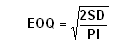
where :
S = Setup costs
D = Demand rate
P = Production cost
I = Interest rate (considered an opportunity cost, so the risk-free rate can be used)
BREAKING DOWN 'Economic Order Quantity - EOQ'
The EOQ formula can be modified to determine different production
levels or order interval lengths, and corporations with large supply chains and high variable costs use an algorithm in computer software to determine EOQ.
How Inventory Impacts Cash-Flow Planning
EOQ
is an important tool for management to minimize the cost of inventory
and the amount of cash tied up in the inventory balance. For many
companies, inventory is the largest asset balance owned by the company,
and these businesses must carry sufficient inventory to meet the needs
of customers. If EOQ can help minimize the level of inventory, the cash
savings can be used for some other business purpose.
Factoring in a Reorder Point
One
component of the EOQ formula calculates a reorder point, which is a
level of inventory that triggers the need to place an order for more
inventory. By determining a reorder point, the business avoids running
out of inventory and is able to fill all customer orders. If the company
runs out of inventory, there is a shortage cost, which is the revenue
lost because the company does not fill an order. Having an inventory
shortage may also mean the company loses the customer or the client
orders less in the future.
Example of Using EOQ
EOQ takes
into account the timing of reordering, the cost incurred to place an
order and costs to store merchandise. If the company is constantly
placing small orders to maintain a specific inventory level, the
ordering costs are higher, along with the need for additional storage
space. Assume, for example, a retail clothing shop carries a line of
men’s jeans and the shop sells 1,000 pairs of jeans each year. It costs
the company $5 per year to hold a pair of jeans in inventory, and the
fixed cost to place an order is $2. The EOQ formula is the square root
of: (2 X 1,000 pairs X $2 order cost) / ($5 holding cost), or 28.284
with rounding. The ideal order size to minimize costs and meet customer
demand is slightly over 28 pairs of jeans. A more complex portion of the
EOQ formula provides the reorder point.
Read more: Economic Order Quantity - EOQ Definition | Investopedia http://www.investopedia.com/terms/e/economicorderquantity.asp#ixzz4TGEg2kaI
Follow us: Investopedia on Facebook


EmoticonEmoticon