


Carrying Costs
What are 'Carrying Costs'
Carrying costs are the costs of holding inventory and include maintenance, specifically in regard to perishable items, and storage costs; insurance and less tangible expenses such as opportunity costs; and losses resulting from theft. The advantage of cyber stores, over brick-and-mortar stores, is the overriding lack of carrying costs. Most online stores stock inventory as it is needed or simply have it shipped from one centralized location instead of keeping inventory in multiple physical locations.BREAKING DOWN 'Carrying Costs'
Carrying costs are also sometimes referred to as carrying cost of inventory or as inventory cost. It is the cost accrued, over a period of time, by holding and storing inventory. This figure is used by businesses to evaluate the level of profit that can reasonably be expected on their current inventory. It is also useful in determining whether goods should be produced less or more so the business can stay on top of expenses and continue to generate a steady income stream.Percentage of Inventory Value
Carrying costs are regularly referred to as a percentage of the business’ inventory value. The percentage indicated may include a number of different costs, such as employee costs, taxes, insurance, depreciation, opportunity costs, the cost of replacing items and even the cost of capital that helps to generate income for the business.Holding Costs
The term "carrying costs" can also be referred to as holding costs. Holding costs are calculated by multiplying the per-unit annual holding cost by the average level of inventory. The average inventory level is equal to the quantity of ordered items, divided by two. As previously indicated, holding, or carrying, costs include any number of expenses related to the holding and warehousing of inventory.Decreasing Carrying Costs
There are a number of options for business owners to decrease the amount spent on carrying costs. The volume of inventory being stored can be limited and the amount of time the inventory spends in storage can also be limited. For businesses that utilize refrigerated warehouse space, this tactic is of specific importance. Improvement of warehouse or storage space may also be an option when trying to lower carrying costs; having an efficient and cost-effective warehouse design and utilizing correct storage techniques likely keeps carrying costs down.Tracking inventory is also an option to help businesses cut down on carrying costs. In most cases, computerized inventory management systems are employed to keep track of inventory levels, as well as the business’ supplies and materials, and are designed to alert owners or management when more or less inventory is needed.
Carrying Cost Of Inventory
What is 'Carrying Cost Of Inventory'
Carrying cost of inventory, or carry cost, is often described as a percentage of the inventory value. This percentage could include taxes, employee costs, depreciation, insurance, cost to keep items in storage, opportunity cost, cost of insuring and replacing items and the overall cost of capital for the company as a whole.BREAKING DOWN 'Carrying Cost Of Inventory'
Also referred to as carry cost of inventory, the carrying cost of inventory is the cost a business incurs over a certain period of time to hold and store its inventory. Businesses use this figure to determine how much profit can be made on current inventory. It also helps businesses find out if there is a need to produce more or less to keep up with expenses or maintain the same income stream.Total Cost of Ownership
The way in which a company manages assets can tell a great deal about its future performance as well as management's efficiency. This is why analysts look at ratios such as return on assets (ROA) and inventory turnover. Inventory generally represents the largest portion of current assets. As such, the management of inventory flows can greatly influence the cost of carrying that inventory. Additionally, the cost of inventory can have a direct impact on the cost of capital and future cash flows.The cost of inventory includes all costs associated with holding or storing inventory for sale. These costs include the opportunity cost of the money used to purchase the inventory, the space in which the inventory is stored, the cost of transportation or handling, and the cost of deterioration and obsolescence.
The opportunity cost of the money used depends on the source of funds used. The cost of funds obtained via internally generated activates is going to be lower than the cost of obtaining funds by issuing equity. The space used to store inventory includes expenses such as rent, depreciation, insurance and other charges associated with maintenance and operational controls such as security, workplace accidents and permits. The cost of obsolescence can be seen in the average amount of write-offs a company has. Perishable or trendy inventory may have a higher cost of obsolescence than non-perishable or staple items.
Inventory Carrying Cost Example
Inventory carrying cost is the cost of owning inventory and is generally expressed in percentage terms. For example, if a company has an inventory carrying cost of 10% and the average annual value of inventory is $1 million, the annual cost of inventory is $100,000. Inventory cost is generally between 20% and 30% of the cost to purchase inventory, but the average rate varies based on the industry and size of business. As such, analysts like to compare the rate against other companies in the same peer group and market capitalization.Holding Costs
What are 'Holding Costs'
Holding costs are the costs associated with storing inventory that remains unsold, and these costs are one component of total inventory costs, along with ordering costs and shortage costs. A firm’s holding costs include the cost of goods damaged or spoiled, as well as the cost of storage space, labor and insurance. Minimizing inventory costs is an important supply chain management strategy.!--break--Inventory and accounts receivable are two asset accounts that may require a large amount of cash, and decisions about inventory spending reduce the amount of cash available for other purposes. For example, increasing the inventory balance by $10,000 means that less cash is available to operate the business each month. This situation is considered an opportunity cost.
Factoring in Inventory Turnover
One way to ensure a company has sufficient cash to operate is to sell inventory and collect payments quickly. The sooner cash is collected from customers, the less total cash the firm must come up with to continue operations. Businesses measure the frequency of cash collections using the inventory turnover ratio, which is (cost of goods sold) / (inventory). For example, a company that has $1 million in cost of goods sold and an inventory balance of $200,000 has a turnover ratio of 5. The goal is to increase sales and reduce the required amount of inventory, so that the turnover ratio increases.Examples of Holding Costs
Assume that ABC Manufacturing produces furniture that is stored in a warehouse and then shipped to retailers. ABC must either lease or purchase warehouse space, and pay for utilities, insurance and security for the location. The company must also pay staff to move inventory into the warehouse, and then load the sold merchandise onto trucks for shipping. The firm incurs some risk that the furniture may be damaged as it is moved into and out of the warehouse.How to Calculate the Reorder Point
Another important strategy to minimize holding costs and other inventory spending is to calculate a reorder point, or the level of inventory that alerts the company to order more inventory from a supplier. An accurate reorder point allows the firm to fill customer orders without overspending on inventory. Companies that use a recorder point avoid shortage costs, which is the risk of losing a customer order due to low inventory levels. The reorder point considers how long it takes to receive an order from a supplier, and the weekly or monthly level of product sales. A reorder point also helps the business compute the economic order quantity (EOQ), or the ideal amount of inventory that should be ordered from a supplier. EOQ can be calculated using inventory software.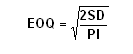
Economic Order Quantity - EOQ
What is an 'Economic Order Quantity - EOQ'
Economic order quantity (EOQ) is an equation for inventory that determines the ideal order quantity a company should purchase for its inventory given a set cost of production, demand rate and other variables. This is done to minimize variable inventory costs, and the formula takes into account storage, or holding, costs, ordering costs and shortage costs. The full equation is as follows:where :
S = Setup costs
D = Demand rate
P = Production cost
I = Interest rate (considered an opportunity cost, so the risk-free rate can be used)
BREAKING DOWN 'Economic Order Quantity - EOQ'
The EOQ formula can be modified to determine different production levels or order interval lengths, and corporations with large supply chains and high variable costs use an algorithm in computer software to determine EOQ.How Inventory Impacts Cash-Flow Planning
EOQ is an important tool for management to minimize the cost of inventory and the amount of cash tied up in the inventory balance. For many companies, inventory is the largest asset balance owned by the company, and these businesses must carry sufficient inventory to meet the needs of customers. If EOQ can help minimize the level of inventory, the cash savings can be used for some other business purpose.Factoring in a Reorder Point
One component of the EOQ formula calculates a reorder point, which is a level of inventory that triggers the need to place an order for more inventory. By determining a reorder point, the business avoids running out of inventory and is able to fill all customer orders. If the company runs out of inventory, there is a shortage cost, which is the revenue lost because the company does not fill an order. Having an inventory shortage may also mean the company loses the customer or the client orders less in the future.Example of Using EOQ
EOQ takes into account the timing of reordering, the cost incurred to place an order and costs to store merchandise. If the company is constantly placing small orders to maintain a specific inventory level, the ordering costs are higher, along with the need for additional storage space. Assume, for example, a retail clothing shop carries a line of men’s jeans and the shop sells 1,000 pairs of jeans each year. It costs the company $5 per year to hold a pair of jeans in inventory, and the fixed cost to place an order is $2. The EOQ formula is the square root of: (2 X 1,000 pairs X $2 order cost) / ($5 holding cost), or 28.284 with rounding. The ideal order size to minimize costs and meet customer demand is slightly over 28 pairs of jeans. A more complex portion of the EOQ formula provides the reorder point.
Langganan:
Postingan (Atom)